A useful MYP maths Criterion A assessment makes students' mathematical choices visible. It needs more than a list of routine calculations: students should select a suitable method, apply it successfully and reach correct solutions across different problems.
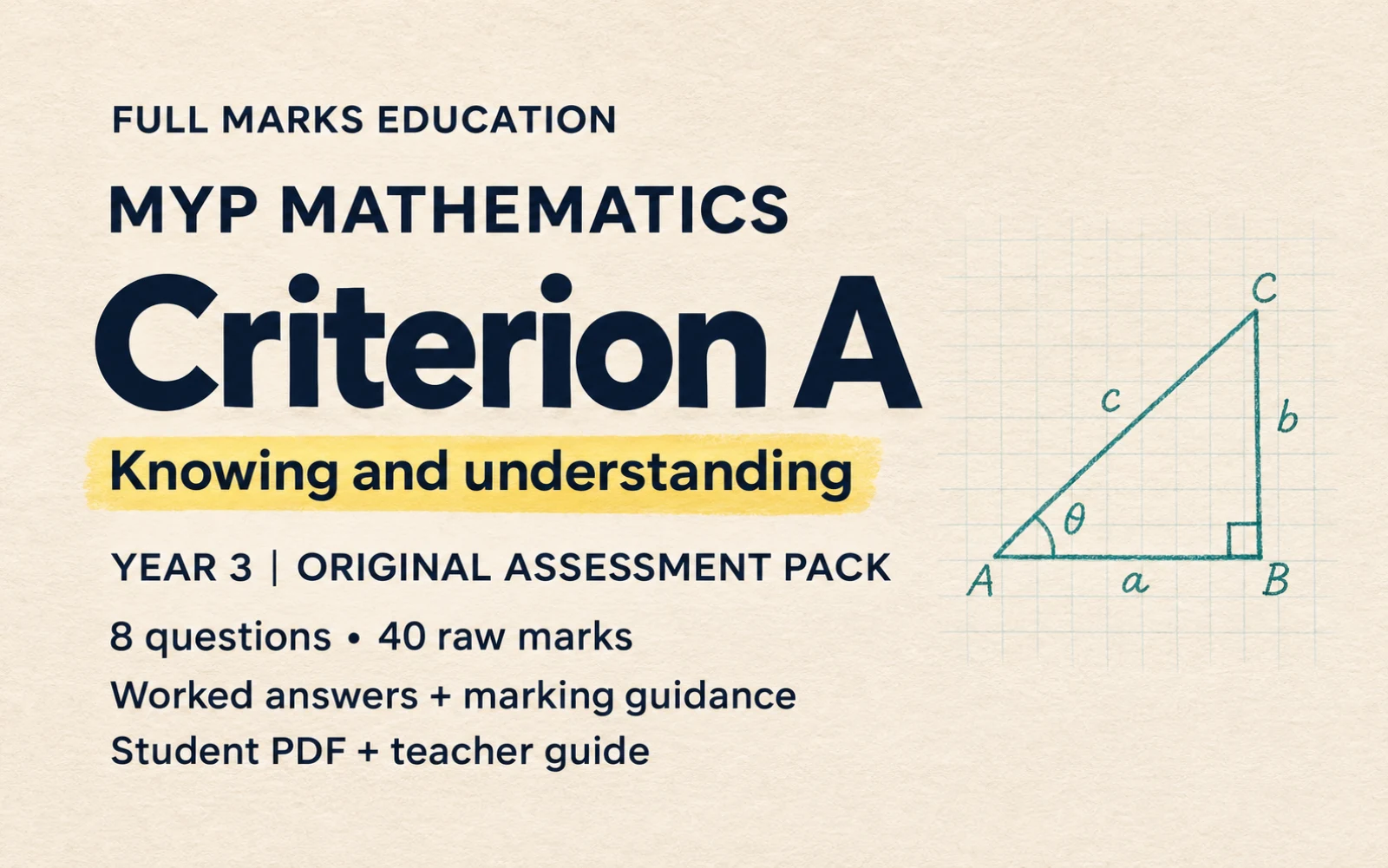
This free, original MYP Year 3 Criterion A assessment pack contains eight questions, worked answers and practical marking guidance. It covers number, algebra, percentages, coordinates, geometry and statistics, with two transfer problems that ask students to connect familiar ideas in less familiar presentations.
Download the free Criterion A assessment pack
Student assessment: four pages, eight questions and working space.
Teacher guide: five pages of worked answers, a 40-mark scheme, diagnostic feedback and moderation guidance.
Download the complete pack - 9-page PDF
Free for classroom copying and internal department sharing. Original material from Full Marks Education; not an official IB examination, endorsed resource or IB-scored exemplar.
What does MYP mathematics Criterion A assess?
Criterion A is Knowing and understanding. The IB mathematics subject brief describes selecting and applying mathematics to solve familiar and unfamiliar problems across a variety of contexts. A correct final answer is valuable, but the working helps a teacher see how the student chose and used the mathematics.
This pack is designed to collect that evidence. It is a suggested Year 3 resource, rather than a universal year syllabus: the MYP mathematics framework allows schools to develop courses suited to their students. Check the prerequisites against your own taught sequence before using it.
What is in the assessment?
| Question | Mathematics | Marks |
|---|---|---|
| 1. Number fluency | Fraction subtraction and powers with negative bases | 4 |
| 2. Algebra fluency | Expansion and a linear equation | 4 |
| 3. Percentage changes | Successive changes and a reverse percentage | 5 |
| 4. A straight line | Gradient, intercept and substitution | 5 |
| 5. A trapezium | Forming and solving an equation from area | 5 |
| 6. A missing data value | Mean, median and range | 5 |
| 7. Two number machines | Order of operations and algebraic justification | 6 |
| 8. A square border | Square roots, lengths and composite area | 6 |
Allow approximately 60 minutes, with a calculator permitted throughout and extra working paper available. This timing is a starting point to trial with your class. Students need prior teaching in the listed topics, including reverse percentages and finding the equation of a line from two points.
Sample question: does the order of two machines matter?
Machine A multiplies its input by 3 and subtracts 2. Machine B divides its input by 2 and adds 5. For an input x, find the output when B is followed by A, then when A is followed by B. Can the two routes ever produce the same output for the same input? Justify your answer for every possible x.
Worked answer: B then A gives 3(x/2 + 5) - 2 = 3x/2 + 13. A then B gives (3x - 2)/2 + 5 = 3x/2 + 4. Their difference is always 9, so the outputs are never equal for the same input. Testing a few inputs suggests a result; the algebra explains why it holds for every input.
The teacher guide awards credit for correctly representing each route, simplifying each expression, and giving a justified conclusion. Formal function-composition notation is not required. This question provides an opportunity to transfer algebraic understanding, but familiarity depends on what your class has already practised.
Sample question: finding the width of a square border
A square tile has side length 12 cm. A smaller square, centred with corresponding sides parallel, has area 64 cm2. Students find the constant border width and its area, then explain why counting only four corner squares misses part of the border.
Worked answer: the inner square has side length 8 cm. The difference of 4 cm includes the border on both sides, so the border is 2 cm wide. Its area is 122 - 64 = 80 cm2. Four 2 cm by 2 cm corner squares account for only 16 cm2; four 8 cm by 2 cm strips provide the other 64 cm2.
A labelled diagram, a subtraction strategy or a correct decomposition can all reveal understanding. Mark the valid mathematics rather than insisting on one presentation.
How should teachers mark the pack?
The guide includes a question-by-question scheme showing method and answer credit, alternative approaches, error-carried-forward conventions, units and common misconceptions. For example, the percentage problem distinguishes applying tax to the discounted price from subtracting percentage points; the coordinate problem distinguishes a correct gradient from a fully correct equation.
The 40 raw marks are not a Criterion A level out of 8. Do not divide the total by five or apply automatic percentage boundaries. Use the applicable year descriptors in your school's current licensed mathematics guide to make a best-fit judgment from the evidence. The guide's summaries of selection, application and correctness are teacher planning prompts, not a replacement official rubric.
For moderation, compare representative scripts and record where students independently selected an appropriate method, applied it successfully and produced correct solutions. Look across the range of questions, including the transfer tasks. If those structures were rehearsed extensively, do not assume that they show unfamiliar problem-solving for your class.
Using the results for feedback
- Procedures secure, selection weak: offer mixed problems without naming the required method.
- Good method, arithmetic slips: ask students to identify the earliest error and check the revised solution.
- Correct examples, incomplete justification: contrast testing several inputs with an argument that covers every input.
- Area and length confused: use a labelled sketch to separate square centimetres from centimetres.
The assessment can also be split into shorter practice sessions. When used formatively, let students correct a response and explain the change before attempting a parallel problem. One script samples learning; it does not replace the school's wider assessment programme.
Build a connected MYP assessment collection
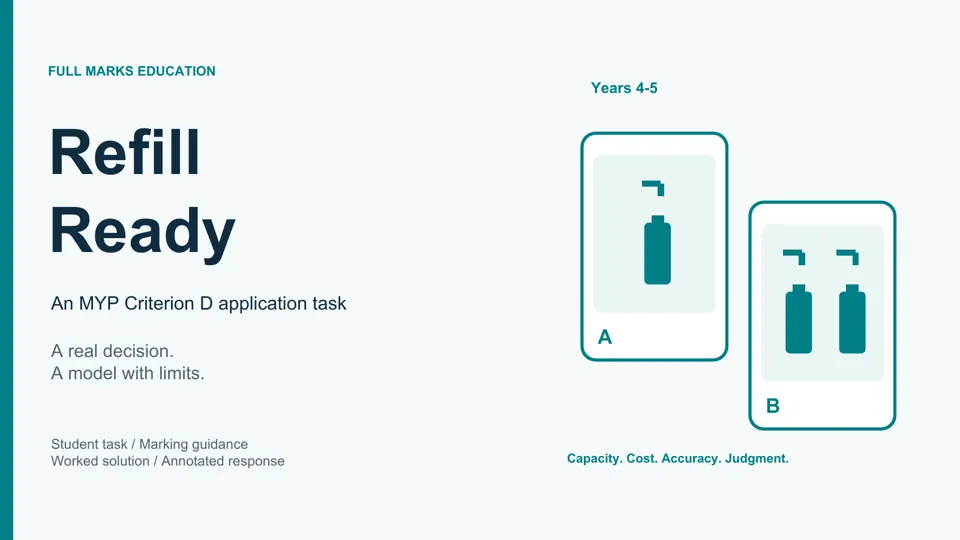
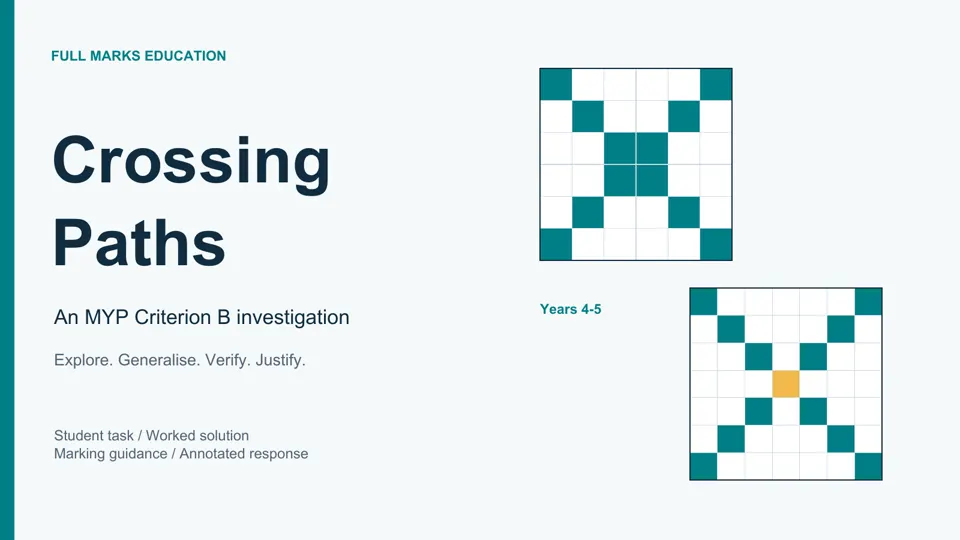
For an overview, read our guide to MYP mathematics Criteria A, B, C and D. For other assessment experiences, try the Crossing Paths Criterion B investigation and the Refill Ready Criterion D application task.
For teaching materials to support a longer sequence, browse our mathematics teacher resources. Choose resources that match the topics your students have actually been taught, then adapt the assessment to the evidence you need.