IB MYP Year 5 Mathematics resources
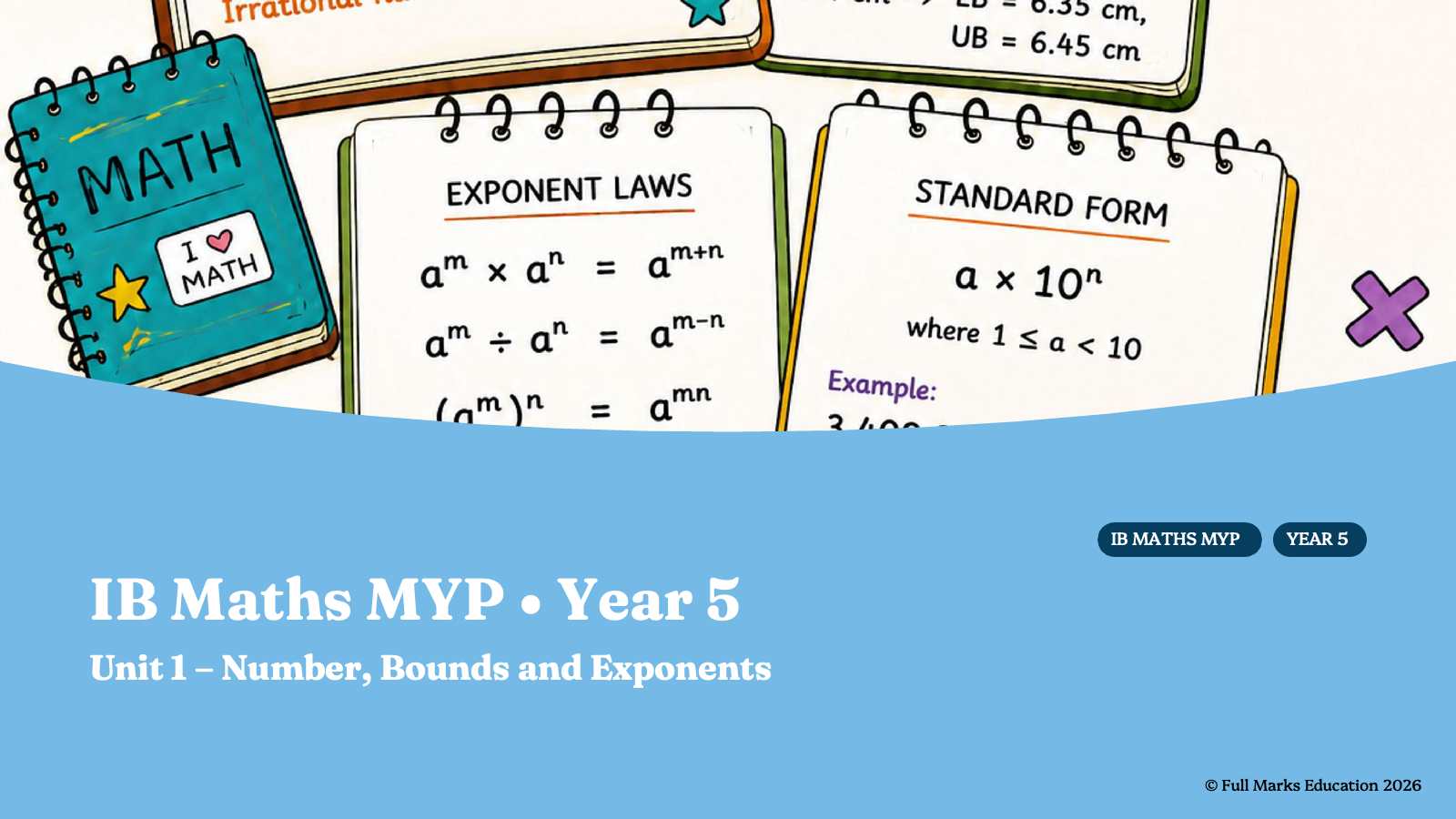
Year 5 is the final stage of the IB MYP mathematics journey. Students need to work confidently with representations, algebraic structure, geometry, data, probability and functions, while also learning how to explain decisions and communicate a complete line of reasoning. The IB MYP Year 5 Mathematics slides are designed to support that transition from guided practice towards independent mathematical thinking.
The repository brings lessons together in a consistent format so teachers can move quickly from the yearly sequence to the exact deck they need. Slides introduce the mathematics explicitly, model methods, provide purposeful problems, create space for inquiry and finish with an exit ticket that gives useful evidence for the next lesson.
A visible tagging system for every lesson
Each slide deck uses a simple tagging system to show the role of each slide. The tags create a predictable rhythm without making lessons feel repetitive:
- Blue tags identify concepts. These slides introduce definitions, notation, representations, relationships and key methods. They give students a clear reference point before they begin working independently.
- Red tags identify problems. These slides ask students to apply the mathematics, interpret information, analyse errors and solve increasingly unfamiliar questions.
- Green tags identify inquiry. These activities invite students to investigate a pattern, test a claim, compare models, make a conjecture or justify a conclusion.
- Purple tags identify exit tickets. These short checks revisit the essential learning and help teachers decide whether to extend, revisit or reteach.
Once students understand the tags, they can anticipate the kind of thinking a slide requires. A blue slide may ask them to notice a relationship, a red slide may ask them to use it, a green slide may ask whether it always works, and a purple slide may ask them to explain what they now understand. The visual language makes the lesson architecture easier to follow for both teachers and learners.
Problems that develop fluency and judgement
Red problem slides are more than collections of exercises. They give students opportunities to choose a method, show working, interpret an answer and decide whether a result is reasonable. Worked examples make the process visible, while later questions remove some of the scaffolding so students can take more responsibility.
A problem about a quadratic model might ask students to identify key features, solve for an unknown, interpret an intersection in context and explain the limits of the model. A geometry problem may require a diagram, a theorem, accurate calculation and a written justification. A statistics problem may ask students to compare distributions, discuss sampling or decide whether a conclusion is supported by the data.
This progression matters in Year 5. Students need procedural fluency, but they also need to recognise which representation is useful, explain why a method works and communicate a conclusion clearly. The slides leave room for teachers to pause, question, annotate and adapt examples for the needs of their class.
Inquiry-based activities connected to the mathematics
Green inquiry slides make investigation part of the ordinary lesson. Students may explore how changing a parameter affects a graph, find examples and counterexamples for a mathematical statement, compare two models or test whether a proposed strategy is efficient. They are encouraged to make predictions before calculating and to use evidence when they revise a conjecture.
Inquiry tasks can also connect mathematics to real decisions. Students might compare data displays and identify how a visual choice changes interpretation, investigate the fairness of a game, optimise a design subject to constraints or evaluate the assumptions behind a model. These activities develop the MYP habits of investigating, communicating and applying mathematics in a real-life context.
The purpose is not to remove explicit teaching. Students are given the definitions, representations and methods they need, then asked to use that knowledge flexibly. This balance helps inquiry feel accessible while still giving students a genuine opportunity to think for themselves.
Exit tickets that inform the next lesson
Purple exit tickets provide a short closing routine. A strong Year 5 exit ticket may combine a calculation with a conceptual question and a one-sentence explanation. Students might solve an equation and explain which solutions are valid, interpret the gradient of a model, identify a misleading statistical conclusion or state an assumption that affects their answer.
These checks are useful because they show more than whether a student reached the expected number. They reveal whether the student can select a method, use notation accurately, interpret the result and communicate the reasoning. Teachers can use that evidence to plan retrieval, targeted support, extension or the starting point for the next lesson.
Designed for the final MYP year
The Year 5 slides support students as they become more independent. Concepts are introduced clearly, methods are broken into manageable steps and practice gradually moves towards unfamiliar contexts. Problems and inquiries ask students to connect representations, justify choices and reflect on the meaning of their answers.
Teachers can use the repository as a ready-to-teach sequence or adapt it to their own programme. Add local data, familiar contexts, technology demonstrations, language support or challenge questions where appropriate. The consistent tags and lesson rhythm make those adaptations straightforward while preserving a clear balance of explanation, practice, investigation and reflection.