IB MYP Year 4 Mathematics slide decks
Year 4 mathematics asks students to move between precise methods, representations, and real situations. They work with increasingly complex algebra, interpret functions and data, justify geometric reasoning, and make decisions under uncertainty. Our IB MYP Year 4 slide collection supports that progression with 55 editable lessons across six connected units.
Each lesson deck is designed to be practical in the classroom and adaptable to the students in front of you. In the editable version of these slides, you can use the sequence as a planning guide, adjust the pace, and add examples or local contexts that make the mathematics meaningful for your class.
There’s structure to anchor your teaching, curriculum pacing, and lesson cadence, but also the simplicity and freedom to make these lessons your own.
Six units that build a broad mathematical toolkit
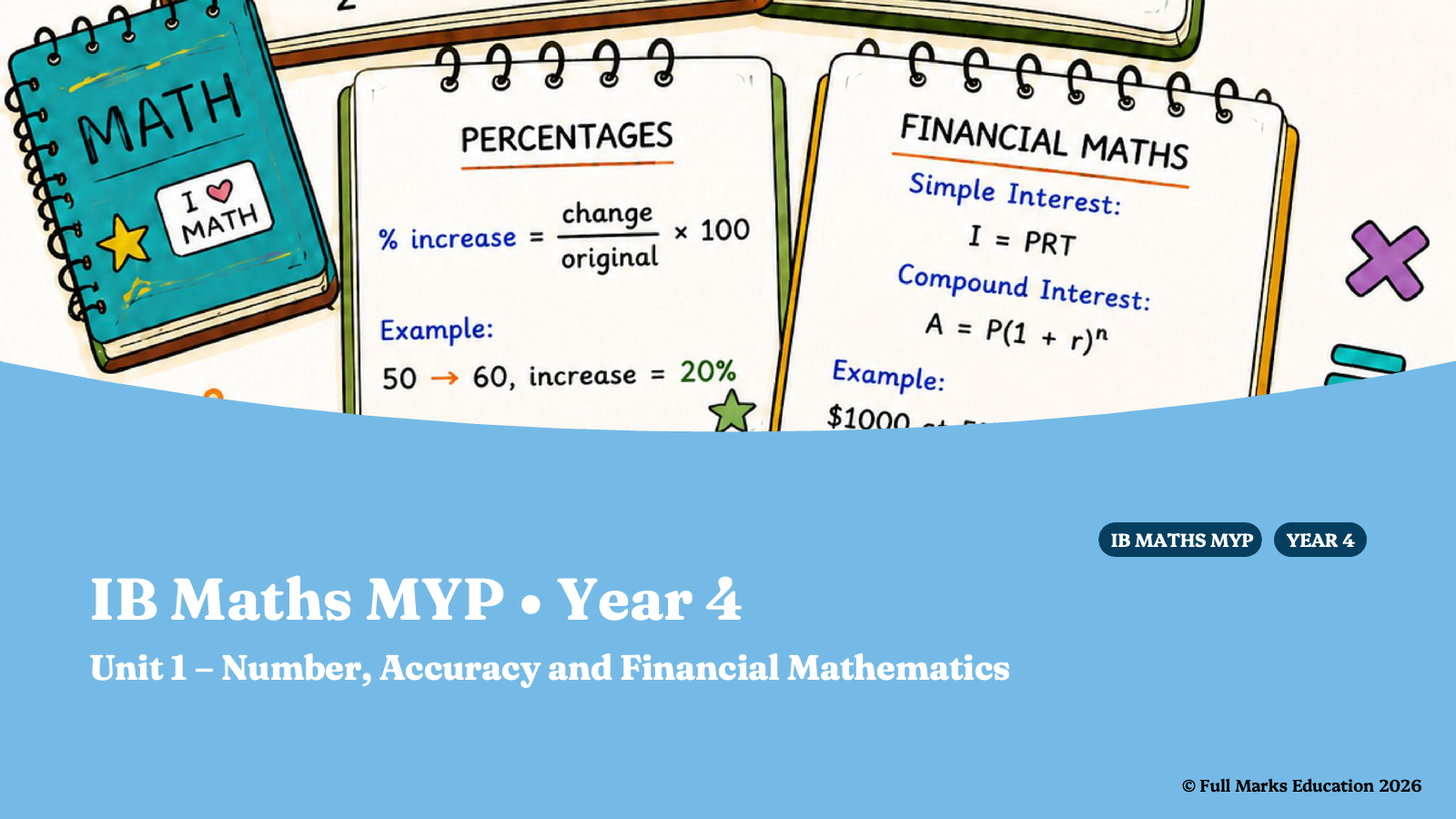
- Unit 1: Number, Accuracy and Financial Mathematics. Students work with number systems and set notation, recurring decimals, bounds and error intervals, standard form, integer and negative indices, percentage change, interest, compound growth and decay, exchange rates and time zones. The unit develops accuracy and helps students judge whether a numerical result is reasonable.
- Unit 2: Algebra and Sequences. Lessons develop algebraic manipulation, expanding double brackets, factorising quadratics and solving quadratic equations by factorisation. Students explore arithmetic and geometric sequences, find and prove rules, rearrange complex formulae and construct algebraic proofs.
- Unit 3: Functions and Mathematical Models. Students use function notation and domain and range, study linear and quadratic functions and their graphs, transform quadratic graphs, solve simultaneous equations, and explore direct and inverse proportion. They also practise selecting, interpreting and validating mathematical models.
- Unit 4: Geometry and Trigonometry. Students apply circle theorems, calculate arc length and sector area, and find surface area and volume of complex solids. They use the Pythagorean theorem and trigonometric ratios to find unknown sides and angles, work with bearings, and develop similarity and congruence proofs.
- Unit 5: Statistics and Regression. Students consider sampling techniques, histograms, cumulative frequency, quartiles, percentiles and interquartile range. They use technology to calculate standard deviation, investigate correlation, fit linear regression models, interpolate and extrapolate, and evaluate the limits of statistical models.
- Unit 6: Probability and Networks. Students use set operations and probability rules, represent compound events with tree diagrams, distinguish independent and dependent events, and study conditional probability and expected frequency. The unit then introduces network language and methods for solving shortest-path problems.
Tags make the purpose of each slide clear
Just as you saw in the slides for the other IB MYP years, these slides have a consistent lesson pacing that is signaled with the use of tags.
Short, consistent tags are quick visual cues that help teachers and students recognise the job a slide is doing.
A Concept tag signals a new idea, definition or relationship.
Then we provide a worked example, showing the method in action, while an Equation slide can focus attention on a key relationship or transformation.
Task and Practice mark opportunities for students to try the mathematics, first with a focused prompt and then with more sustained application. The Solution makes reasoning available for discussion and checking.
Real-world connection and Inquiry invite students to apply ideas, investigate a question or explain what a result means.
Finally, reflection with an exit ticket wraps the lesson nicely and helps student solidify what they have just been exposed to.
The tags give the lesson a visible structure without forcing every topic into an identical script.
Some lessons need several concept steps or worked examples; others move quickly into investigation. The repeated labels help students orient themselves while teachers retain flexibility.
A predictable cadence from introduction to independent thinking
A typical lesson opens by making the learning goal clear, then introduces the new mathematics through a concept slide.
A worked example unpacks the reasoning one step at a time. Students then move into a task or practice questions, followed by a solution they can use to check methods, discuss errors and refine their explanations.
Where the topic allows, a real-world connection or inquiry prompt extends the learning. Students might justify a circle theorem, compare models, interpret a regression line or decide which route is shortest in a network. The lesson closes with a chance to explain, check or apply the central idea independently.
This cadence makes it easier to plan a complete lesson: introduce the idea, model the thinking, let students practise, review the reasoning and extend the mathematics.
The interplay of consistency and flexibility, now partners instead of adversaries, give students a familiar routine, so more attention can go to the content and less to figuring out what each slide expects them to do.
Use the sequence, then adapt it
The Year 4 slides provide a coherent route through number, algebra, functions, geometry, statistics and probability.
Teachers can follow that route or adapt individual lessons to match their course map. Pairing the slides with the related notes, worksheets and inquiry activities can provide additional explanation, practice and application around the same ideas.
Use the resource button above to browse the IB MYP Year 4 Maths slide folders.
Want the full editable collection? The Year 4 Core + Extension Slide Deck Bundle includes the Unit 4 Geometry and Trigonometry lessons.